Thanks to everyone at the office for showing their support for the Jeans for Genes Campaign
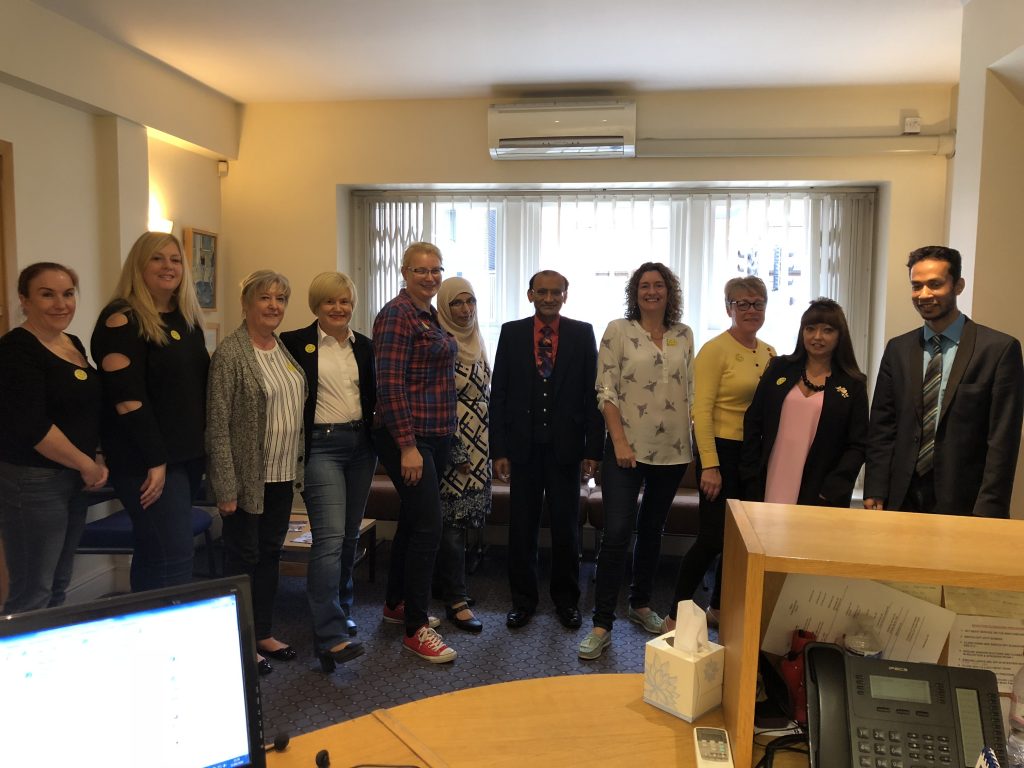


Thanks to everyone at the office for showing their support for the Jeans for Genes Campaign
Saturday 18 August has been reported as the most common day in 2018 to tie the knot in the UK. However, since the early 1970s, the number of people actually getting married has steadily decreased, dropping a further 3.4% last year. There have been many theories about why marriage rates are falling, but regardless the fact remains that fewer people are formalising their relationship.
In 2016 there were 3.3m cohabiting couples or around 6.6million cohabiting adults. This is officially the fastest growing family type, more than doubling from 1.5million couples just 20 years ago. Yet, a 2017 ComRes survey showed that only one couple in three knew there was no such thing as common law marriage.
The issue is widespread, with nearly 98% of professionals from family justice group Resolution reported having worked with a cohabiting couple who they were unable to help. A further 90% said the couples are often surprised to find out about their lack of rights.
To help raise awareness of this issue Rhona Royle from Wrigley Claydon Solicitors in Oldham and Todmorden is campaigning to raise awareness and encourage cohabiting couples to take steps protect themselves and their families.
Rhona explains: “If an unmarried couple breaks up, they would not necessarily be entitled to share in (what they thought were their) joint assets, such as a house they may have made significant financial contributions to, if they aren’t named as an owner on the deed. This is the same regardless of how long they have been together or whether they have children.”
In the absence of action from government, these couples need to know that they are not given rights through common law marriage but they can take appropriate actions to protect themselves. For example signing a cohabitation agreement is an easy and cost effective way to get financial peace of mind without getting married or forming a civil partnership.”
Much has been written in the press recently about grieving families paying thousands of pounds to Banks to administer a loved one’s estate. This has come about as a result of a Will Writing Service many Banks offered in the late 1990’s and early 2000’s where the Bank was often appointed as executor. In some circumstances it is appropriate and advisable to appoint a professional as executor, for example, if an estate is complex or it is suspected family members would not be able to get along and work together. However, typically the Banks reserved the right to charge fees for their services far in excess of what families considered fair and proper given the size and nature of an estate.
If you have one of these Wills appointing a Bank as executor it is not too late to rectify the situation. A Will can be changed any time before death if you still have the mental capacity to do so. After death the beneficiaries can ask the Bank to renounce i.e give up the right to administer the estate if work has not yet commenced.
If you would like to review your Will, write a first Will or discuss the appointment of professionals as executors, please contact our Wills department on 0161 624 6811 option 3 or email Rachel Damianou on rld@wrigleyclaydon.com for a free initial consultation.
Louise Brown, the World’s First Baby conceived via IVF was born on the 25th July 1978, at Oldham General Hospital.
On 10th November 1977, Louise’s Mother, Lesley Brown underwent a procedure, later to become known as in vitro fertilisation (IVF), developed by Patrick Steptoe, Robert Edwards and Jean Purdy.
Patrick Steptoe was a client of Wrigley Claydon Solicitors, and at the time Paul Vincent, who was a junior parnter, was asked to draw up legal papers for a research trust to be set up by Steptoe and Professor Bob Edwards concerning the whole IVF issue which the pair were pioneering.
Robert Edwards, whose research enabled IVF won a Nobel prize. Although the media referred to Louise Brown as a “test tube baby”, her conception actually took place in a petri dish.
Source: Oldham Chronicle

As part of our pledge to Oldham’s Dementia Action Alliance, Caremark Oldham and Wrigley Claydon are running FREE ‘Let’s Talk about Dementia’ sessions for those interested in understanding a bit more about dementia and the small things you can do to help people with the condition.
A diagnosis of dementia can seem daunting but information and advice will be available for anyone who wishes to find out more about the condition and how to prepare for the challenges ahead.
Caremark Oldham will run a Dementia Friends session aiming to transform the way people think, act and talk about the condition. Stigma and lack of understanding cause many people with dementia to experience loneliness and social exclusion, so Dementia Friends hopes to tackle this by creating more communities and businesses that are dementia-friendly and more inclusive of people affected by dementia.
Wrigley Claydon will run a question and answer session aimed at meeting people’s concerns about the legalities involved when a loved-one is diagnosed with dementia covering protecting your home in case care home fees become an issue and how to manage financial and health decisions when a loved one can no longer do so themselves.
Join us for our friendly, informative sessions being held at The Conservative Club, High Street, Uppermill on Wednesday 4th July; Wednesday 18th July; Wednesday 19th September and Wednesday 10th October 2018 at 10.00am.
Wrigley Claydon – 0161 624 6811
Victims of domestic violence continue to be cross-examined by their abusers in family courts despite the government the then justice secretary, Liz Truss, pledging in February 2017 to ban the “humiliating and appalling” practice, a report by Women’s Aid and Queen Mary University of London has found.
Survivors reported they were repeatedly not believed, blamed for experiencing abuse, and seen as unstable by judges, barristers and Cafcass officers. One woman said her abusive ex-partner was able to cross-examine her about her sexual history during child contact proceedings.
A Ministry of Justice spokesperson said: “We will legislate to ban the unacceptable practice of abusers cross-examining their victims in the family court as soon as possible. The law is clear that the child’s welfare is paramount, and it is for judges to determine what is best for the child after careful consideration of the facts in each case.”
If you are looking for family advice then please call 0161 624 6811 (option 3) to speak to our Family Department.
FirstGroup chief executive Tim O’Toole has stepped down with “immediate effect”, after the bus and train operator reported a huge full-year loss.
The company said lost £327m in the year to 31 March, compared with a profit of £152.6m last year.
The group also runs South Western Railway, the Heathrow Airport Connect service and First Bus, as well as the Greyhound in the US.
If you are considering a company merger, acquisition, takeover or joint venture or are in the midst of a shareholder dispute or share capital transaction or need business advice please contact us. Call 0161 624 6811 (Option 4) to speak to John Porter and Soibi Iketubosin in our Company/Commercial Department or email jap@wrigleyclaydon.com or si@wrigleyclaydon.com
James Campbell, the only son of his late mother Sarah who was told by his late mother ‘it’s all yours’ is defeding a High Court claim for over half of his inheritance of £725,000 by his mother’s last boyfriend, Andrew Banfield.
James Campbell also claims that this mother’s will, drawn up 14 years before her death in 2015, handed most of her estate – including the keys to his childhood home – to him.
Mr Banfield says he and Mrs Campbell lived as ‘husband and wife’ for more than 20 years before her death and he needs a payout from her estate to buy his own home.
However, Mr Campbell says Mr Banfield has plenty of money of his own and denies the relationship between his mother and Mr Banfield was as close as he says.
The court heard that all agree that Mr Banfield’s relationship with Mrs Campbell began in the early 1990s after the death of Mr Campbell’s father.
Mr Banfield claims to have moved into her Thames Ditton home in 1993 and that they became engaged in 1999.
From then until her death, they lived as a couple, with her partially maintaining him in her home.
But Mr Campbell denies there was ever an engagement and says Mr Banfield did not move in until 2002.
Mr Campbell argued that Mr Banfield is not entitled to anything from the estate, beyond a £5,000 gift which Mrs Campbell left him in her will and that he does not need it anyway, as he has money and an income of his own with which to buy or rent a property.
The court heard Mr Banfield claims he needs at least £420,000 to buy a suitable property in the village. The hearing continues.
Wills and Probate disputes can be very complex and require expert legal guidance to resolve matters as fairly as possible.
At Wrigley Claydon, we fight on your behalf to make this difficult time a little easier, whether you are bringing a claim or you are on the receiving end. We are experienced in this field and have won complex cases for our clients.
As it is an emotional time we deal with your case sensitively.
If you are looking for dispute advice please contact us. Call 0161 624 6811 (Option 6) to speak to Shalish Mehta, in our civil and commercial litigation department or email sm@wrigleyclaydon.com.
Mr Justice Turner threw out the challenge from a claimant in the case of Rashid v Munir & Ors who wanted a share of profits from rental properties run by his brothers after their father’s death.
Of the claimant, he stated: ‘I do not believe him on this or indeed any other material matter’. The first defendant’s evidence was ‘unhelpful’ and the second defendant was ‘as heroically dishonest as he is in his everyday life’. The third defendant was described as giving evidence in a ‘facetious manner’, which included winking at the claimant’s counsel and showing he regarded telling the truth as ‘simply no more than a lifestyle choice’.
The judge added: ‘Attempting to establish the common but unstated intention of a group of individuals all giving honest but conflicting evidence is difficult enough. Where, as here, each witness is attempting to outdo the other in a rich display of competitive dishonesty, the task of the judge is unenviable.’
The judge’s conclusion that the claimant was not entitled to claim a share of the commercial rents was ruled unassailable and the appeal dismissed.
Suffering a financial or contractual dispute can have serious implications on your business. Our business solicitors will quickly and efficiently put your case together and act on your behalf. Call Shalish Mehta in our civil and commercial litigation department on 0161 624 6811 (Option 6) or email sm@wrigleyclaydon.com. We can advise you on the appropriate course of action and assist with any legal documents or proceedings that may occur.